
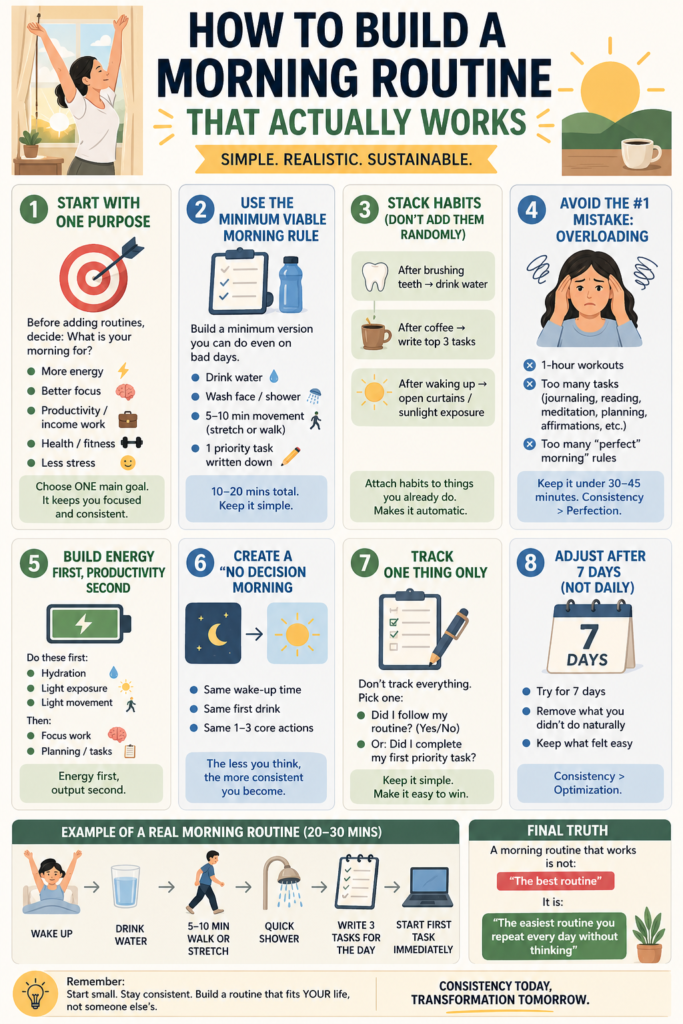
A morning routine only works when it’s designed around your real life—not an ideal version of it. Most people fail because they copy influencer routines that are too long, too rigid, or not connected to an actual goal.
Here’s a simple, realistic system that actually sticks.
1️⃣ Start With ONE Purpose (Not 10 Habits)
Before adding routines, decide:
👉 What is your morning for?
Choose one main goal:
⚡ More energy
🧠 Better focus
💸 Productivity or income work
🏃 Health and fitness
😌 Less stress
Without a clear purpose, your routine becomes random and inconsistent.
2️⃣ Use the “Minimum Viable Morning” Rule
Don’t build a perfect routine. Build the smallest version you can still do on bad days.
Example:
Basic Morning (10–20 mins total):
💧 Drink water
🚿 Wash face or shower
🚶 5–10 minutes of movement (stretch or walk)
✍️ Write down one priority task
That’s enough. Everything else is optional.
3️⃣ Stack Habits Instead of Adding Them Randomly
Attach new habits to things you already do naturally.
Example:
After brushing teeth → drink water
After coffee → write your top 3 tasks
After waking up → open curtains for sunlight
This reduces reliance on motivation and makes routines automatic.
4️⃣ Avoid the Biggest Mistake: Overloading
Most routines fail because people try to do too much:
❌ 1-hour workouts
❌ Journaling + reading + meditation + planning + affirmations
❌ Too many “perfect morning” rules
👉 If your routine takes more than 30–45 minutes, it becomes harder to sustain consistently.
5️⃣ Build Energy First, Productivity Second
A strong morning routine starts with physiology before productivity.
Do these first:
💧 Hydrate
🌞 Get sunlight or bright light exposure
🚶 Move your body lightly
Then move into:
🧠 Focus work
📱 Planning and tasks
Energy first. Output second.
6️⃣ Create a “No-Decision Morning”
Decision fatigue destroys consistency.
Simplify your mornings with:
⏰ Same wake-up time
🥤 Same first drink
✅ Same 1–3 core actions
The less thinking required, the easier the habit becomes.
7️⃣ Track Only ONE Thing
Don’t track everything.
Choose one simple metric:
✔️ Did I follow my routine today? (Yes or No)
or
✔️ Did I complete my first priority task?
Keep tracking simple enough that you’ll actually continue doing it.
8️⃣ Adjust After 7 Days — Not Every Day
Don’t keep redesigning your routine daily.
Instead:
📅 Try it for 7 days
🗑️ Remove habits you naturally avoided
✅ Keep the parts that felt easy and sustainable
Consistency beats optimization.
⚡ Example of a Realistic Morning Routine (20–30 Minutes)
⏰ Wake up
💧 Drink water
🚶 5–10 minute walk or stretch
🚿 Quick shower
✍️ Write 3 tasks for the day
🧠 Start the first important task immediately
💡 Final Truth
A morning routine that works is not:
“The best routine.”
It’s:
“The easiest routine you can repeat every day without thinking.”