
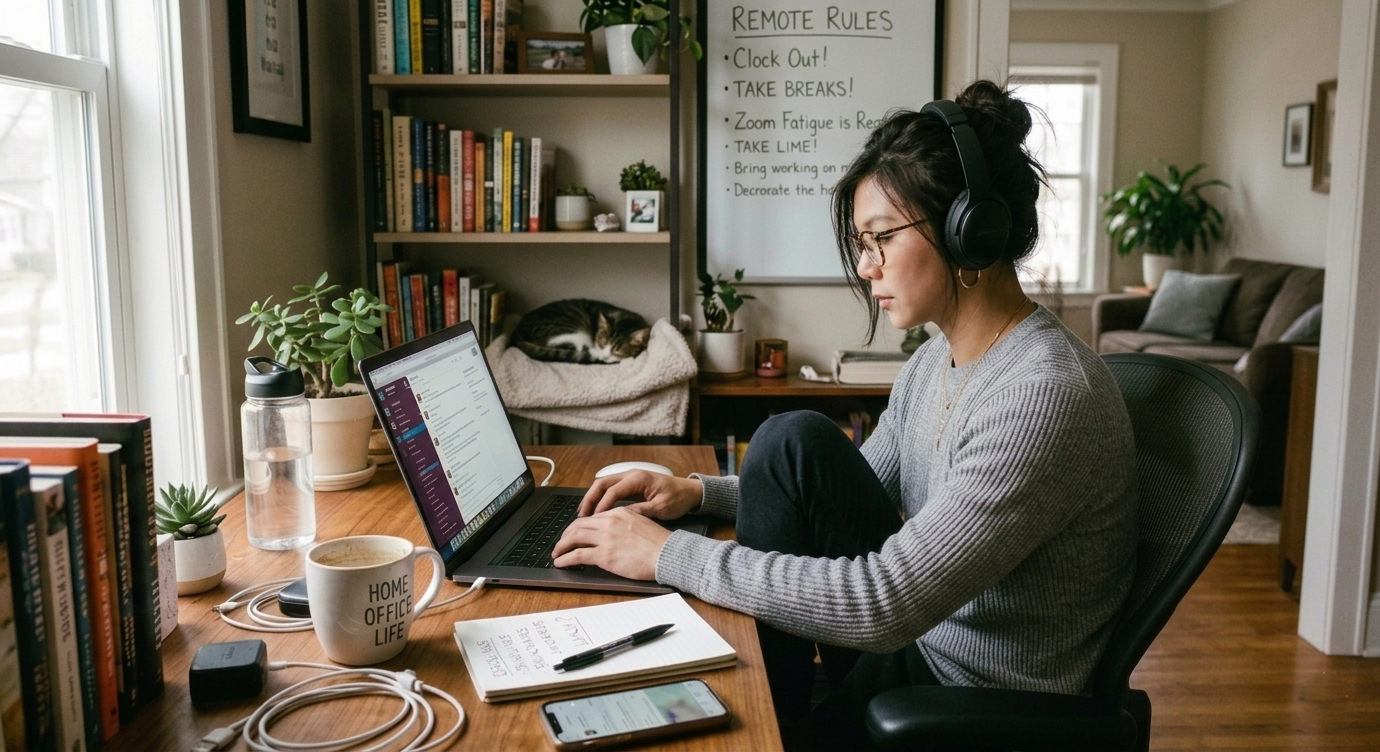
Working from home sounds like the dream setup.
No exhausting commutes.
No strict dress codes.
No office politics.
No overpriced lunches that barely fill you up.
Social media often paints remote work as a perfect lifestyle—working beside a cozy cup of coffee, in a clean minimalist setup, while enjoying complete freedom in pajamas.
But after living the remote work life for a while, you start realizing there’s another side nobody talks about.
Working from home isn’t automatically better than office work.
It’s just a completely different lifestyle with its own challenges.
1️⃣ Your Workday Can Quietly Take Over Your Entire Night
In a traditional office setup, going home creates a natural boundary.
Once you leave the building, your brain understands:
“Work is done for today.”
But at home, that separation disappears.
You open “one last email” at 7 PM.
You finish “one quick task.”
Then suddenly it’s already 10 PM and you’re still working.
Because your laptop is always nearby, many remote workers end up working longer hours than they ever did in an office.
Not always because the company demands it—but because it becomes difficult to truly disconnect.
2️⃣ Being Home All Day Can Feel Surprisingly Lonely
At first, the silence feels peaceful.
But over time, it can start feeling heavy.
You begin to miss the tiny social interactions you never appreciated before:
• Casual hallway greetings
• Random office jokes
• Coffee break conversations
• Complaining together about broken printers or deadlines
Without those small moments, the days can start blending together—especially if you live alone.
Remote work can sometimes feel isolating in ways people rarely expect.
3️⃣ Your Home Slowly Stops Feeling Like “Home”
One of the strangest parts of WFH is how work slowly invades your personal space.
Your dining table becomes your office desk.
Your bedroom becomes a stress zone.
Your couch becomes a second workstation.
Instead of feeling like a place to relax, your home starts feeling like a permanent office.
That’s why experienced remote workers become protective of dedicated workspaces—even if it’s only a small corner of a room.
Mental separation matters more than people realize.
4️⃣ Flexibility Is Both a Blessing and a Trap
Flexibility is one of the biggest advantages of remote work.
Ironically, it’s also one of the hardest things to manage.
Without structure, bad habits appear quickly:
❌ Waking up 5 minutes before meetings
❌ Skipping meals
❌ Working late into the night
❌ Procrastinating all day then rushing at midnight
Remote work rewards self-discipline.
The people who thrive long-term usually build strong routines:
✔️ Consistent wake-up schedules
✔️ Regular breaks away from screens
✔️ Clear working hours
✔️ “Digital sunset” routines where work notifications stop completely
5️⃣ People Think You’re Always Available
One hidden struggle of working from home is that many people assume you’re free all day.
You’ll eventually hear things like:
“Can you receive this package since you’re home anyway?”
“Can you do this quick errand?”
“Can you watch the kids or pets for a while?”
One of the biggest skills remote workers learn is setting boundaries.
Being physically at home does NOT mean you’re available.
6️⃣ Zoom Fatigue Is Real
Video meetings can be mentally exhausting in a completely different way.
You constantly monitor your face on camera.
You stare at screens for hours.
You try to read body language through tiny windows.
You deal with awkward delays and interruptions.
A full day of online meetings can drain your energy faster than many in-person meetings ever did.
🌤️ The Small Things You Eventually Appreciate
Despite the challenges, remote work also brings meaningful benefits that genuinely improve life.
Over time, you stop caring about the “work in pajamas” fantasy and start appreciating the real advantages:
✔️ Saving hours from daily commuting
✔️ Having control over your environment
✔️ Eating better meals at home
✔️ Spending more time with family, pets, or loved ones
✔️ Having flexibility that traditional offices often can’t provide
🧠 The Bottom Line
Working from home isn’t a perfect paradise.
But it’s not a disaster either.
It’s simply a different operating system for your career and lifestyle.
At the end of the day, success in remote work has less to do with your laptop setup or internet speed—and more to do with your habits, boundaries, discipline, and ability to protect your peace while living and working under the same roof.